Press "Enter" to skip to content

JS Tech Road

LeetCode 19. Remove Nth Node From End of List (Javascript)

Given the head of a linked list, remove the nth node from the end of the list and return its head.

Follow up: Could you do this in one pass?

Example 1:
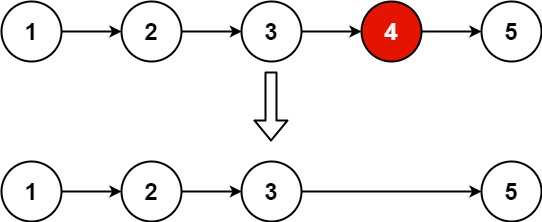
Input: head = [1,2,3,4,5], n = 2
Output: [1,2,3,5]

Example 2:

Input: head = [1], n = 1
Output: []

Example 3:

Input: head = [1,2], n = 1
Output: [1]

Constraints:

  • The number of nodes in the list is sz.
  • 1 <= sz <= 30
  • 0 <= Node.val <= 100
  • 1 <= n <= sz
/**
 * Definition for singly-linked list.
 * function ListNode(val, next) {
 *     this.val = (val===undefined ? 0 : val)
 *     this.next = (next===undefined ? null : next)
 * }
 */
/**
 * @param {ListNode} head
 * @param {number} n
 * @return {ListNode}
 */
var removeNthFromEnd = function(head, n) {
    if (head.next === null) 
        return null;
    
    let first = new ListNode();
    first.next = head;
    let second = first;
    // first point to n + 1
    first = first.next;
    while (n > 0) {
        first = first.next;
        n--;
    }
    // first already reach to the end null, means need to remove the first node
    if (first === null) {
        head = head.next;
    } else {
        // maintaining N nodes apart between first and second pointer
        while (first !== null) {
            first = first.next;
            second = second.next;
        }
        // Now second pointer to the node that need to be removed
        // remove that node now
        second.next = second.next.next;
    }

    return head;
    
};
LeetCode 2. Add Two Numbers

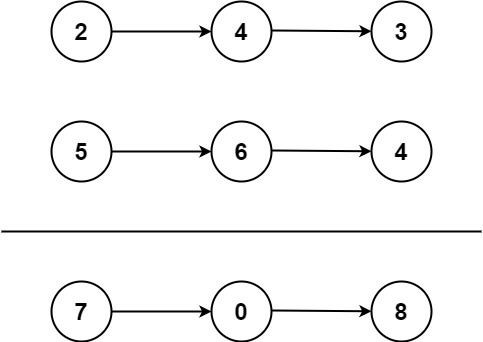
You are given two non-empty linked lists representing two non-negative integers. The digits are stored in reverse order, and each of their nodes contains a single digit. Add the two numbers and return the sum as a linked list.

You may assume the two numbers do not contain any leading zero, except the number 0 itself.

Example 1:

Input: l1 = [2,4,3], l2 = [5,6,4]

Output: [7,0,8]

Explanation: 342 + 465 = 807.

Example 2:

Input: l1 = [0], l2 = [0]

Output: [0]

Example 3:

Input: l1 = [9,9,9,9,9,9,9], l2 = [9,9,9,9]

Output: [8,9,9,9,0,0,0,1]

Constraints:

  • The number of nodes in each linked list is in the range [1, 100].
  • 0 <= Node.val <= 9
  • It is guaranteed that the list represents a number that does not have leading zeros.
/**
 * Definition for singly-linked list.
 * function ListNode(val, next) {
 *     this.val = (val===undefined ? 0 : val)
 *     this.next = (next===undefined ? null : next)
 * }
 */
/**
 * @param {ListNode} l1
 * @param {ListNode} l2
 * @return {ListNode}
 */
var addTwoNumbers = function(l1, l2) {
    let head = new ListNode();
    let temp = head;
    let sum = 0;
    let carry = 0;
    while (l1 !== null || l2 !== null) {
        sum = carry + (l1 !== null ? l1.val : 0) + (l2 !== null ? l2.val : 0);
        carry = sum >= 10 ? 1 : 0;
        sum = sum % 10;
        
        temp.next = new ListNode(sum);
        temp = temp.next;
        
        if (l1) l1 = l1.next;
        if (l2) l2 = l2.next;
        
        if (carry) temp.next = new ListNode(carry);
    }
    return head.next;
};

LeetCode 387. First Unique Character in a String

Given a string, find the first non-repeating character in it and return its index. If it doesn’t exist, return -1.

Examples:

s = "leetcode"
return 0.

s = "loveleetcode"
return 2.

Note: You may assume the string contains only lowercase English letters.

Idea: Hashtable

Solution:

/**
 * @param {string} s
 * @return {number}
 */
var firstUniqChar = function(s) {
    let map = new Map;
    
    for (let i = 0; i < s.length; i++) {
        if (map.has(s[i])) {
            map.set(s[i], map.get(s[i]) + 1);
        } else {
            map.set(s[i], 1);
        }
    }
    
    for (let i = 0; i < s.length; i++) {
        if (map.get(s[i]) === 1) return i;
    }
    return -1;
};

LeetCode 1. Two Sum

Problem:

Given an array of integers, return indices of the two numbers such that they add up to a specific target.

You may assume that each input would have exactly one solution, and you may not use the same element twice.

Example:

Input: nums = [2,7,11,15], target = 9

Output: [0,1]

Output: Because nums[0] + nums[1] == 9, we return [0, 1].

Idea:

Hashtable

Solution:

Hashtable / Javascript

Time complexity: O(n)

Space complexity: O(n)

/**
 * @param {number[]} nums
 * @param {number} target
 * @return {number[]}
 */
var twoSum = function(nums, target) {
    let map = new Map();
    
    for (let i = 0; i < nums.length; i++) {
        let diff = target - nums[i];
        if (map.has(diff)) {
            return [i, map.get(diff)];
        } else {
            map.set(nums[i],i);
        }
    }
};